4
Four phases
- Awareness
- Regulation
- Capacity Building
- Integration
A cycle you run on repeat until your baseline moves. Notice where you are, bring yourself back, stretch what you can hold, then make the new level your normal.

A free book by Scott Oldford
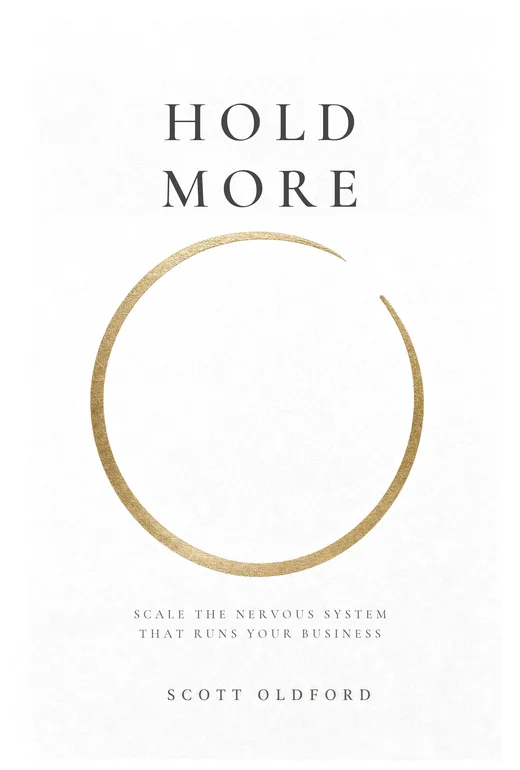
Hold More trains you to hold more. 138 pages, 31 practices, and research that tells you where it’s strong and where it’s thin.
Written for online Entrepreneurs, from fifteen years working with more than 10,000 of them.
Sound familiar?
Your system hit its capacity. That’s all that happened. When you can’t hold it, you avoid it.
“There’s really only two ways to scale a business and hold it together. Either you scale your nervous system... or you numb out.”Scott Oldford, from a post that kept getting shared
Where this came from
On the last day of my first million-dollar launch, my girlfriend at the time found me in the elevator of our condo building in Toronto. I was riding it up and down, standing in the corner, talking to myself.
That was 2016. The launch added 55,000 people to my email list in under a week. After it, I traveled and did nothing for months. I couldn’t function.
Three years before that I was 21, sitting in an accountant’s office in Moncton, New Brunswick, over half a million dollars in debt. He told me in plain language that the math did not work.
In 2013 my nervous system collapsed under pressure. In 2016 it collapsed under the win.
Everyone prepares you for how hard it is to survive failure. Almost nobody prepares you for how much capacity it takes to survive success.
The part that gives me hope
For years, a FedEx truck pulling up to my door set off my whole body. Legal documents, tax notices, money I owed. Long after the debt was gone, the spike still fired.
Then one day the truck showed up and my first thought was: my juices are here. Same truck. Retrained system.
Capacity can be trained. That’s what this book is for.
How good can you take it?
What’s inside
A cycle you run on repeat until your baseline moves. Notice where you are, bring yourself back, stretch what you can hold, then make the new level your normal.
Name the state you’re in first, then pick the tool that matches it. The wrong tool for your state can make things worse.
All five are free. Breath is free. A walk is free. Calling a friend is free.
A map of where you are now, so you can check in 30 days and see if your stage has shifted.
Each one is written the same way. What it is, why it works, what to do right now, what it feels like when it lands, and how people get it wrong. A few of them:
Before anything else, the book gives you a simple test. Are you stressed, or are you burnt out? If rest restores you, you build capacity the way the book describes. If you’re burnt out, the protocol flips: warmth, sleep and subtraction, with no stress on purpose until your baseline comes back.
What the research actually says
Three research groups using three different methods found the same thing. Chronic stress damages judgment, planning and flexible thinking. Most of that damage reverses once the stress comes down.
A 2026 study of identical twins found the self-employed twin reported 24 percent more stress, with evening cortisol about 53 percent higher. Long hours explained the gap. It hasn’t been repeated yet, and the book says so.
Most nervous system content treats it as settled science. In 2026, 39 researchers published a paper arguing it doesn’t hold up. The book uses it as a working model and tells you that straight.
You’ve probably heard that 72 percent of founders have a mental illness. The study behind it used a narrow comparison group. The book walks you through why it’s weaker than it sounds.
Who it’s for
Start with one practice
Pick one practice. Run it every day for a week before you add a second. The book shows you which one to start with.
Nothing here is medical advice. I’m not a practitioner. If you’re in real danger, if you’re thinking about hurting yourself, or if what’s happening needs clinical care, call someone now. A doctor, a crisis line, a person who can get to you.